

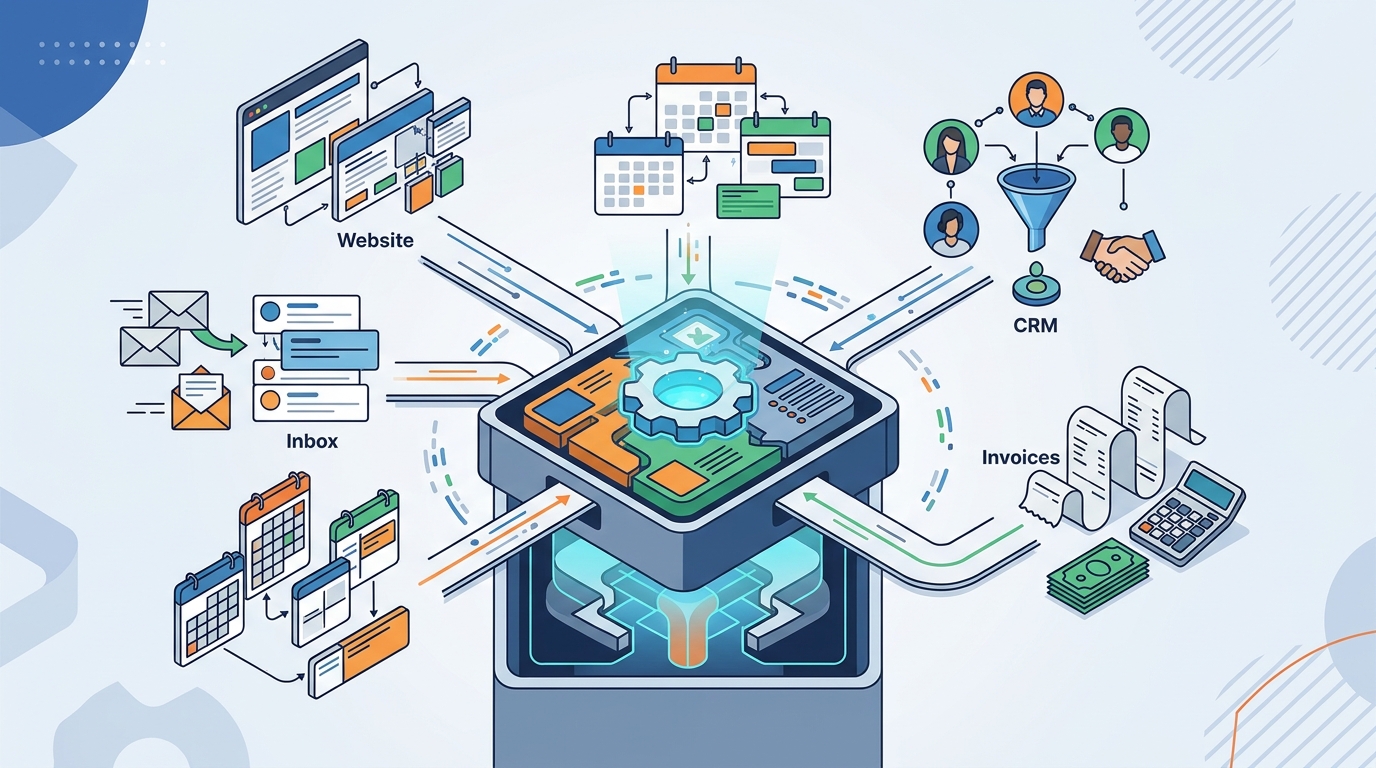
HubSpot integration unifies your business tools by connecting your website, inbox, calendar, CRM, and invoices into a single, centralized platform. This consolidation eliminates data silos and ensures that every customer interaction is tracked in one place. For Houston-based businesses, The Roy Effect helps implement these connections to streamline operations and improve lead management.
The Problem with Disconnected Systems
Most small businesses operate with a fragmented stack of tools. A website builder, a separate email client, a standalone calendar, and a basic CRM often do not talk to each other. This fragmentation creates data silos where critical customer information gets lost or duplicated. When a lead fills out a form on your website, that data should automatically appear in your CRM. Without integration, you must manually copy and paste this information, which is time-consuming and prone to error.
The cost of this manual labor is significant. Employees spend hours every week switching between applications to find the latest status of a client. This inefficiency slows down response times and can lead to missed opportunities. A unified platform ensures that when a lead interacts with your website, your team is notified immediately via email or dashboard. This real-time visibility allows for faster follow-up, which is crucial for conversion.
Centralizing Customer Data in the CRM
A Customer Relationship Management (CRM) system is the backbone of any unified business platform. It serves as the single source of truth for all customer interactions. When your website forms, email signatures, and calendar bookings are integrated with your CRM, every touchpoint is logged automatically. This means you can see a complete history of a lead, from their first website visit to their final invoice payment.
For example, if a prospect downloads a whitepaper from your site, the CRM records that action. If they then book a discovery call, the CRM links that event to their profile. This level of detail helps sales teams tailor their conversations. Instead of asking a prospect what they have already seen, you can reference specific content they engaged with. This personalization builds trust and demonstrates that you understand their needs.
Automating Routine Tasks and Follow-ups
Integration enables powerful automation workflows that handle routine tasks without human intervention. For instance, when a new lead is created in your CRM, an automated email can be sent to the sales team. Simultaneously, a task can be created to follow up within 24 hours. This ensures that no lead goes cold, regardless of how busy your team is.
Automation also extends to invoicing and billing. When a deal is marked as closed in your CRM, the system can automatically generate an invoice and send it to the client. This reduces administrative overhead and accelerates cash flow. By connecting your CRM to your accounting software, you eliminate the need to manually enter billing details. This seamless flow of data ensures that your financial records are always up to date and accurate.
Connecting Your Website to Your CRM
Your website is often the first point of contact for potential customers. Integrating your website with your CRM ensures that every interaction is captured and tracked. This includes form submissions, page views, and button clicks. By using tracking pixels or integration plugins, you can monitor which pages a visitor views before they convert. This behavioral data provides valuable insights into customer interests and pain points.
For local businesses in Houston, this integration is particularly important. Many customers search for local services online before making a decision. If your website is not connected to your CRM, you may not know which specific service pages are driving leads. By analyzing this data, you can optimize your website content and marketing efforts to focus on the services that generate the most revenue. The Roy Effect specializes in building websites that are designed to convert and integrate seamlessly with your existing tools.
The Benefits of a Unified Platform
A unified platform offers several key benefits for business owners and teams. First, it improves data accuracy by eliminating manual data entry. Second, it increases efficiency by automating routine tasks. Third, it provides a holistic view of customer relationships, enabling better decision-making. When all your tools are connected, you can see the full picture of your business operations in one place.
This unified view also simplifies reporting and analytics. Instead of exporting data from multiple systems and combining it in a spreadsheet, you can generate reports directly from your CRM. These reports can show you key metrics such as lead conversion rates, sales cycle length, and revenue by service. This data-driven approach allows you to identify areas for improvement and make informed strategic decisions.
Key Takeaways
- HubSpot integration connects your website, inbox, calendar, CRM, and invoices into a single platform.
- Data silos created by disconnected tools lead to inefficiency and missed opportunities.
- A centralized CRM serves as the single source of truth for all customer interactions.
- Automation workflows handle routine tasks like follow-ups and invoicing without manual effort.
- Website integration tracks visitor behavior to provide insights into customer interests.
- A unified platform improves data accuracy, efficiency, and decision-making.
- The Roy Effect helps Houston businesses implement these integrations to streamline operations.
Frequently Asked Questions
What is HubSpot integration?
HubSpot integration is the process of connecting HubSpot with other business tools such as websites, email clients, calendars, and accounting software to create a unified platform.
Why is a unified platform important for small businesses?
A unified platform is important because it eliminates data silos, reduces manual data entry, and provides a complete view of customer interactions, leading to improved efficiency and better decision-making.
How does website integration with a CRM work?
Website integration with a CRM works by using tracking pixels or plugins to capture visitor data and form submissions, which are then automatically logged in the CRM for tracking and follow-up.
Can HubSpot integrate with my existing accounting software?
Yes, HubSpot can integrate with various accounting software solutions to automate invoicing and billing processes, ensuring that financial records are synchronized with your CRM.
What are the benefits of automating follow-ups?
Automating follow-ups ensures that leads are contacted promptly, reducing the risk of them going cold. It also frees up your team's time to focus on high-value tasks.
How can The Roy Effect help with HubSpot integration?
The Roy Effect helps Houston businesses implement HubSpot integration by building conversion-focused websites and connecting them with your existing tools to create a seamless, unified platform.
Conclusion
HubSpot integration is a powerful way to unify your business tools and streamline your operations. By connecting your website, inbox, calendar, CRM, and invoices into a single platform, you can eliminate data silos and improve efficiency. The Roy Effect is here to help you make the most of these integrations. To get started, book a discovery call with our team to discuss how we can help you unify your business tools.